
Night sweats
Night sweats are very common. But they can sometimes be a symptom of leukaemia or another blood cancer. Learn about signs to look for and when to get help for night sweats.
Summary
- Night sweats are very common. They’re usually nothing to worry about.
- But drenching night sweats can sometimes be a symptom of leukaemia or other types of blood cancer.
- Most people with night sweats do not have blood cancer.
- If you regularly have night sweats that soak through your nightwear or bedding, make an appointment with your GP.
About night sweats
Sweating is a normal response to being hot. It helps your body cool down. How much you sweat depends on how hot it is, what you’re doing and what time of day it is. And some people naturally sweat more than others.
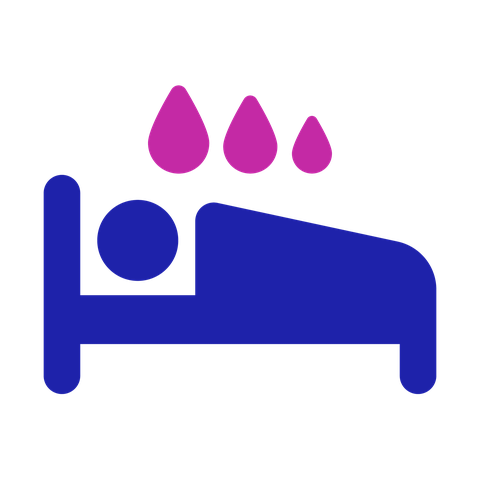
It’s very common to sweat at night. It often happens if you’re in a hot room or your bedclothes are too warm. But regularly sweating so much it soaks your nightwear and bedding can be a symptom of leukaemia and other types of blood cancer.
Like all symptoms of leukaemia, getting night sweats does not mean you definitely have leukaemia. But if you’re worried about your symptoms, it’s a good idea to see your GP.
Between 1 and 4 in every 10 people who visit their GP say they get night sweats, if they are specifically asked about them. This shows how common night sweats are. They are rarely serious.
Why do people with blood cancer get night sweats?
We don’t know exactly why people with leukaemia or other blood cancers get night sweats. There are a few possible causes.
Cancer can activate an inflammatory response in your body. This helps your immune system fight the cancer, but it also raises your temperature. Your body responds by sweating to try to lower your temperature.

Anxiety can increase the activity of your sweat glands. So if you’re worrying about having cancer, it might make you sweat more.

If you’re awake for another reason, including worrying about cancer, you might be more aware of night sweats you wouldn’t usually notice.
What else can cause night sweats?
Night sweats can be caused by lots of things. Most people who have them do not have blood cancer.
Other things that can cause night sweats include:
- A hot bedroom or too many bedclothes
- Drinking alcohol
- Menopause or perimenopause
- Pregnancy, including after giving birth
- Infections
- Acid reflux
- Anxiety or depression
- Overactive thyroid
- Low blood sugar levels
- Sleep problems
- Some medicines
- Some autoimmune conditions
- Other types of cancer
When to seek help
If you regularly wake up sweating so much your nightwear or bedding is soaked, make an appointment with your GP.
Nearly 4 in 10 people with leukaemia wait 3 months or more before contacting a GP about their symptoms.
Some signs that you should contact your GP include drenching night sweats that:
- Happen regularly, even if your bedroom is cool
- Wake you up
- Soak you so much you have to change your nightwear and bedding
- Are accompanied by other symptoms of blood cancer
- Affect your sleep so you feel tired or groggy in the daytime
If you have drenching night sweats and swollen lymph nodes or a swollen spleen, your GP is likely to offer you a blood test. If they don’t, ask them about it. They may refer you urgently to rule out cancer.
If you are struggling to get help
Nearly 3 in 10 people with leukaemia have to speak to their GP three or more times before getting a diagnosis.
There may be many possible explanations for your symptoms for a GP to consider.
If you have to go back to your GP three or more times about the same symptom, remind them about Jess’ rule. This encourages GPs to ‘reflect, review and rethink’, particularly if:
- You still have the symptoms
- They have got worse
- They are unexplained
Take a look at our Spot Leukaemia campaign to find out what we’re doing to help the public and GPs spot the signs of leukaemia sooner.
Advocacy support
Our advocacy service can help you understand how to make an appointment and access the tests you need.
Sources
We used an AI tool to help identify relevant evidence sources for this webpage, such as scientific journals and clinical guidelines. A human checked the reliability of these sources.
Sources we used to develop this information
Black GB, Boswell L, Harris J, Whitaker KL. What causes delays in diagnosing blood cancers? A rapid review of the evidence. Primary Health Care Research & Development. 2023 Jan;24:e26. DOI: https://doi.org/10.1017/S1463423623000129
Clarke RT, Jones CH, Mitchell CD, Thompson MJ. ‘Shouting from the roof tops’: a qualitative study of how children with leukaemia are diagnosed in primary care. BMJ Open. 2014 Feb;4(2):e004640. DOI: https://doi.org/10.1136/bmjopen-2013-004640
Clarke RT, Van den Bruel A, Bankhead C, Mitchell CD, Phillips B, Thompson MJ. Clinical presentation of childhood leukaemia: a systematic review and meta-analysis. Archives of Disease in Childhood. 2016 Oct 1;101(10):894-901. DOI: https://doi.org/10.1136/archdischild-2016-311251
Howell DA, Smith AG, Jack A, Patmore R, Macleod U, Mironska E, Roman E. Time-to-diagnosis and symptoms of myeloma, lymphomas and leukaemias: a report from the Haematological Malignancy Research Network. BMC Blood Disorders. 2013 Oct 31;13(1):9. DOI https://doi.org/10.1186/2052-1839-13-9
Mold JW, Holtzclaw BJ, McCarthy L. Night sweats: a systematic review of the literature. The Journal of the American Board of Family Medicine. 2012 Nov 1;25(6):878-93. DOI: https://doi.org/10.3122/jabfm.2012.06.120033
National Institute for Health and Care Excellence (NICE). Clinical Knowledge Summary: Haematological cancers - recognition and referral. Revised 2025. Available at: https://cks.nice.org.uk/topics/haematological-cancers-recognition-referral/ [Accessed May 2026]
National Institute for Health and Care Excellence (NICE). Clinical Knowledge Summary: Tiredness/fatigue in adults. Revised June 2025. Available at: https://cks.nice.org.uk/topics/tiredness-fatigue-in-adults/ [Accessed May 2026]
National Institute for Health and Care Excellence (NICE). Suspected cancer: recognition and referral. NICE guideline NG12. 23 June 2015; updated 25 April 2026. Available at: https://www.nice.org.uk/guidance/ng12 [Accessed May 2026]
NHS cancer programme: faster diagnosis framework. November 2022. Available at: https://www.england.nhs.uk/publication/cancer-programme-faster-diagnosis-framework/ [Accessed May 2026]
NHS England. National Cancer Patient Experience Survey 2024. Available at: https://www.ncpes.co.uk/latest-national-results/ [Accessed May 2026]
NHS Scotland. Scottish referral guidelines (SRGs) for suspected cancer: Haematological cancers. Available at: https://www.rightdecisions.scot.nhs.uk/scottish-referral-guidelines-srgs-for-suspected-cancer/haematological-cancers/ [Accessed May 2026]
Viera AJ, Bond MM, Yates SW. Diagnosing night sweats. American Family Physician. 2003 Mar 1;67(5):1019-24.
Need support?
You are not alone. We're here for you whether you have a diagnosis yourself or know someone who has. If you'd like advice, support, or a listening ear, call our freephone helpline on 08088 010 444 or send a WhatsApp message to 07500 068 065.
Help us improve our information
We aim to provide information that’s reliable, up-to-date, and covers what matters to you. Please complete our short survey to help us improve our information and make sure it meets your needs.
About our information
This information is aimed at people in the UK. We do our best to make sure it is accurate and up to date but it should not replace advice from your health professional. Find out more about our information.
Page last reviewed: 10 September 2026
Updated October 2026
Next review due: 30 September 2029
Related content
Spot Leukaemia
Spot Leukaemia is an awareness campaign created by Leukaemia Care to raise awareness of the …
What is leukaemia?
Leukaemia is a type of blood cancer. It starts when cells in your bone marrow …
Just diagnosed with leukaemia
It can be hard to know where to start and what to do after a …
Advocacy support
Free advocacy support for people affected by leukaemia. Get help with work, healthcare, treatment decisions, …
Tests and diagnosis
Leukaemia is usually diagnosed using blood tests and bone marrow tests. You might also need …
Types of leukaemia and related blood cancers
There are many types of leukaemia, myeloproliferative neoplasms and myelodysplastic syndromes. Find out about the …
Need help understanding this information?
Our support team is here to answer your questions and provide guidance.
Contact Support